Phishing attacks cost organizations an average of $4.88 million per breach in 2024, with 3.4 billion phishing emails sent daily and AI-generated campaigns achieving 54% click-through rates: 4.5 times higher than traditional attacks. With 68% of breaches involving human error and 84.2% of phishing attacks bypassing DMARC authentication, choosing the right phishing email tools has become mission-critical for organizations of all sizes.
The market has evolved into two distinct categories: simulation and training platforms that build internal resilience by testing employees, and brand protection tools that eliminate external attacks targeting customers before damage occurs.
Understanding the Two Categories of Phishing Email Tools
Understanding both categories of phishing email tools and selecting the right combination can deliver ROI ranging from 562% to 50x while protecting customer trust and employee credentials.
Simulation & Training Platforms
Simulation and training platforms focus on your internal workforce, sending fake phishing emails to test awareness and provide immediate education when employees fail. These tools measure click rates, track improvements over time, and build the “human firewall” that transforms employees from your weakest link into a detection layer.
Brand Protection & Detection
Brand protection and detection tools operate entirely differently. These platforms monitor the internet, social media, app stores, and dark web to identify real phishing sites impersonating your brand. When customers forward suspicious emails to your abuse mailbox, these tools automatically analyze phishing threats, coordinate takedowns with hosting providers, and eliminate malicious infrastructure, often within hours.
The distinction matters because they solve fundamentally different problems. Simulation tools protect your organization from internal threats, while brand protection tools defend customers from external scams that damage reputation and steal revenue. Most organizations need both for defense-in-depth.
Leading Phishing Simulation and Training Platforms
GoPhish is the only completely free, open-source option, offering custom email templates, landing pages, real-time tracking, and campaign automation. Security teams with technical expertise value its flexibility and powerful API, but it requires infrastructure management and offers no built-in training content.
KnowBe4 dominates the commercial market with over 70,000 customers, combining the world’s largest security awareness training library with unlimited phishing simulations using 2,000+ templates. Pricing ranges from $16-30 per user annually, with enterprise organizations consistently rating it 4.6/5 stars for ease of deployment and comprehensive content.
Cofense PhishMe leverages threat intelligence from 35+ million trained users to deliver highly realistic simulations with 1,500+ customizable templates. Their Responsive Delivery feature sends simulations when users are actually active, with custom pricing targeting mid-to-large enterprises in regulated industries.
Proofpoint Security Awareness Training integrates deeply with Proofpoint’s email security platform at approximately $18 per user annually, providing adaptive learning paths and multi-vector simulations with proven 40% reductions in clicks on malicious links.
Brand Protection Tools: Defending Your Customers and Revenue
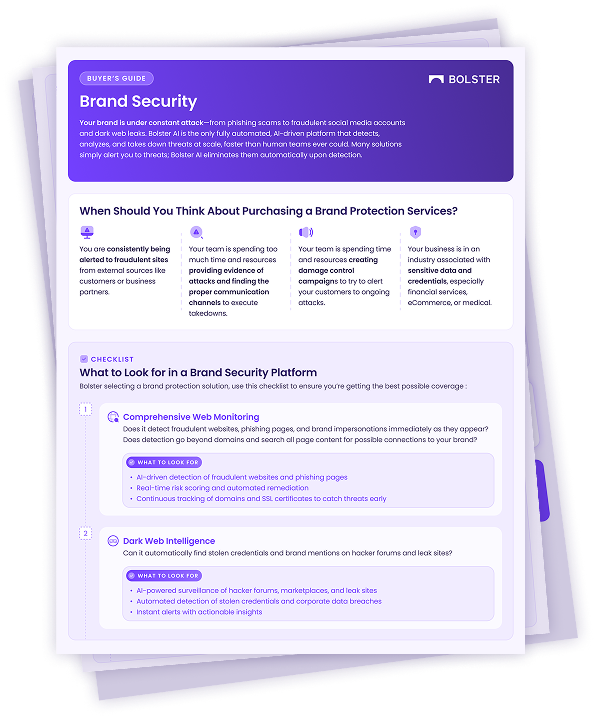
While simulation tools train employees to recognize threats, brand protection tools eliminate the phishing sites and scam emails that target your customers—protecting revenue, reputation, and customer trust.
Bolster’s Customer Abuse Mailbox represents the gold standard in brand protection by fully automating the customer-reported phishing lifecycle. Large brands receive upwards of 30,000 customer reports monthly, with approximately 35% being legitimate threats. Bolster’s platform analyzes each submission using eight advanced LLM-based transformers trained on the industry’s largest structured phishing dataset, achieving 99.999% accuracy with just 0.001% false positives, eliminating the alert fatigue that overwhelms security teams.
The crowdsourcing capability sets Bolster apart. Customers who receive brand impersonation phishing forward suspicious emails to the company’s abuse mailbox, creating early threat detection before internal security teams even see attacks. This matters because research shows 15% of scammed customers never return to the brand, making prevention of customer-facing threats essential for retention and revenue protection.
Bolster’s system automatically identifies threat infrastructure, initiates takedowns through direct API partnerships with global hosting providers, and notifies customers once threats are neutralized: all without manual intervention in 95% of cases. Average takedown time is just 2 minutes, with 75% of threats eliminated in under 60 seconds. Compare this to the industry standard of 10-12 days for manual takedown processes, and the competitive advantage becomes clear.
Beyond email, Bolster’s platform provides comprehensive protection across domain monitoring, social media, app stores, and dark web monitoring: creating unified visibility across all external attack surfaces.
Why Investment in Phishing Email Tools is Critical
The phishing landscape has fundamentally transformed. Over 1 million phishing attacks occurred in Q4 2024 alone, with attack volume increasing 1,265% since ChatGPT’s release. AI-generated campaigns now account for 73.8% of all phishing emails analyzed, creating unprecedented scale and sophistication.
Financially, the case for investing in phishing email tools is overwhelming. Comprehensive security awareness training costs just $10-30 per user annually, yet delivers returns ranging from 69% for small businesses to 562% for large enterprises. Organizations implementing AI-driven security save an average of $2.2 million per breach compared to those without protection, with best-in-class programs achieving 50x ROI.
Business Email Compromise caused $2.77 billion in U.S. losses in 2024, with average wire transfer requests reaching $128,980. Organizations without incident response teams face breach costs of $5.29 million versus $3.26 million with proper preparation—a $2 million difference that dwarfs the cost of preventative tools.
How to Choose the Right Solution for Your Organization
Start by identifying your primary pain point. If employees frequently click phishing simulations or attacks bypass your email gateway, prioritize simulation platforms. If customers report brand impersonation or you face reputational damage from external scams, brand protection tools should lead your evaluation.
For small businesses under 100 employees, consider GoPhish for internal training if you have technical staff. For brand protection, Bolster provides enterprise-grade detection and automated takedowns without requiring large security teams.
For mid-size organizations (100-1,000 employees), KnowBe4 or Proofpoint offer strong simulation platforms. Pair these with Bolster’s AI-powered brand protection to defend both internal and external attack surfaces with monthly phishing simulations and continuous external threat monitoring.
Learn more about external attack surface management
For enterprises over 1,000 employees, evaluate Cofense or Proofpoint for training, then add Bolster for comprehensive brand protection. Bolster’s ability to process 30,000+ monthly customer reports with 95% automation makes it ideal for high-volume environments where manual analysis is impossible.
Critical evaluation criteria include deployment speed (cloud solutions deploy in minutes vs. weeks for on-premise), integration with your security stack (SIEM, SOC tools, identity providers), and automated response capabilities. Bolster’s direct API partnerships with hosting providers and registrars enable 2-minute automated takedowns that manual processes simply cannot match.
Best Practices for Maximum Protection
Deploy layered defense combining technical controls (DMARC set to “reject,” secure email gateways, AI-based behavioral analysis) with human training. Research shows employees retain anti-phishing skills for only four months, making quarterly training minimum with monthly reinforcement preferred.
For simulation platforms, increase difficulty over time using the NIST Phish Scale methodology. Never shame users who fail; provide immediate just-in-time training and celebrate those who report threats. Organizations rewarding reporting behavior see 20% of employees actively flagging threats.
For brand protection, automate your abuse mailbox with AI-powered analysis. Manual triage of customer-reported phishing is unsustainable at scale: Bolster’s platform handles this automatically while maintaining 99.999% accuracy. Integration amplifies effectiveness: connect phishing tools to SIEM platforms for centralized visibility and SOAR platforms for orchestrated response.
Protect Your Brand and Your Customers with Bolster
The sophistication and volume of phishing attacks will only increase as generative AI makes creating convincing campaigns trivial for attackers. Organizations need comprehensive strategies addressing both internal workforce preparedness and external brand protection.
Security awareness training transforms employees into detection assets. Brand protection tools like Bolster defend the customers who may never interact with your security team, preventing the 15% permanent customer loss that follows successful brand impersonation scams.
With average breach costs approaching $5 million and ROI ranging from 50x to 562%, even modest investments in the right tools pay for themselves many times over while protecting your organization’s most valuable assets: customer trust, employee credentials, and brand reputation.
Ready to see how Bolster protects your brand and customers from phishing threats? Schedule a demo to see our AI-powered platform detect and eliminate threats in real-time, or explore our solutions to learn how we deliver 99.999% accuracy with 2-minute automated takedowns.